

























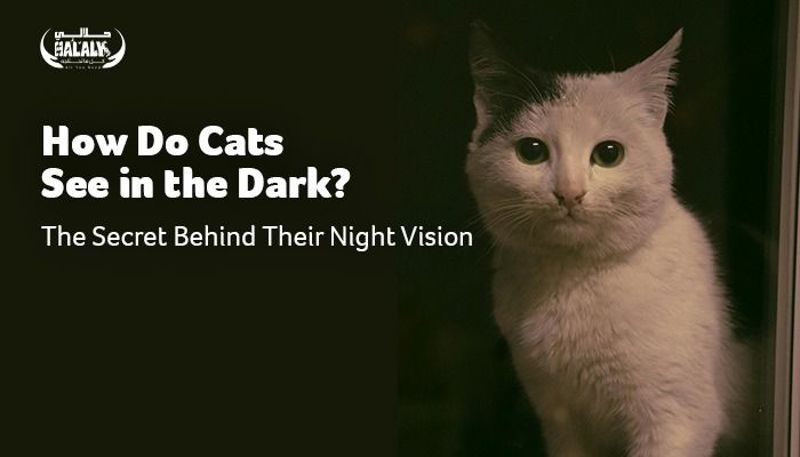
If you’ve ever wondered whether cats can see in complete darkness, the answer lies in the unique structure of their eyes and their exceptional ability to capture light far better than humans. Cats possess advanced night vision, making them highly skilled in low-light conditions—explaining their nighttime activity and hunting prowess.
Can Cats See in the Dark? The Truth About Their Night Vision
It may sometimes seem as if cats move through total darkness as if they have their own light, but in reality, their night vision depends on utilizing even the tiniest sources of ambient light.
How Strong Is a Cat’s Vision Compared to Humans?
Cats can see in light levels up to 6 times dimmer than what humans require for clear vision.
Their ability to detect movement in near-darkness makes them excellent hunters, even when humans can’t see a thing.
Why Do Cats Need Night Vision?
Most cats are naturally active at night or dawn—prime hunting times in the wild.
Night vision allows them to navigate darkness easily, monitor their surroundings, and avoid obstacles or surprises.
How Do Cat Eyes Work? The Anatomy Behind Their Super Vision
To understand how cats see and why they excel at night, we need to examine the structure of their eyes. Cat eyes are designed as precise light-gathering machines, converting minimal light into clear images that guide their movement and hunting.
Large Pupils and Light Capture
One key secret of feline night vision is their large pupils, which expand significantly compared to humans.
When light dims, the pupils open wide, allowing as much light as possible to enter. This gives cats the ability to move freely even in nearly pitch-black areas—similar to using a camera with a wide aperture in low-light conditions.
The Tapetum Lucidum: The Light-Reflecting Layer
Cats’ glowing eyes at night are not just cute—they reveal the Tapetum Lucidum, a reflective layer behind the retina.
This layer acts like a mirror, bouncing light back onto the retina and giving the eye a “second chance” to capture light and form a clear image. That’s why cats’ eyes appear to shine when exposed to light at night.
Rod Cells and Night Vision
The retina of a cat’s eye contains numerous rod cells, specialized for vision in low light.
These cells are highly sensitive to light, allowing cats to detect movement much more precisely than details.
At night, a cat may not distinguish colors well but can detect even subtle motion—making them exceptional hunters.
Can Cats See in Complete Darkness?
Many people assume cats can see in total darkness, but they actually need at least a tiny amount of light, even if it’s barely noticeable.
So, can cats see in the dark? Yes—but not in 100% pitch-black conditions.
How Much Light Do Cats Need?
Cats can see with 6–8 times less light than humans need. Even faint sources, like streetlight through a window or dim reflections, are enough to activate their night vision.
Suggested Product: To help your cat navigate the house at night, use soft LED lights in hallways or play areas.
Example: Flexible Cat Feather Toy with Night Light
Light vs. Total Darkness for Cats
-
Dim Light: Cats see clearly and can accurately judge movement and distance.
-
Complete Darkness: Vision is impaired; cats rely on hearing and smell to move.
-
Moderate Light: Their visual and movement abilities combine for peak performance.
If your cat hesitates to move at night, dim lighting can help them avoid bumping into furniture.
How Night Vision Helps Cats Hunt
Night vision isn’t just an amazing biological trait—it’s an essential hunting tool during dawn and night hours.
Detecting Prey Movement
Even nearly motionless prey can be detected thanks to the sensitive rod cells in the retina. This makes cats highly effective hunters even in near-total darkness.
Suggested Product: Flexible Cat Feather Toy simulates prey movement and stimulates hunting instincts.
Using Vision, Hearing, and Smell Together
Cats don’t rely on sight alone—they combine night vision, sharp hearing, and a strong sense of smell to locate prey accurately:
-
Hearing: Determines direction
-
Smell: Determines distance
-
Sight: Detects motion
This combination makes cats some of the most skilled predators in the animal kingdom.
How Cats See Close-Up at Night
Cats excel at focusing on nearby objects during night hunting, especially when approaching prey. They rely on precise timing, determining the target’s location in fractions of a second before pouncing.
Suggested Product: Provide a comfortable play-area bed for nighttime activity so your cat can rest safely afterward: Soft Cat Bed
What Do Cats Actually See? Colors and Shapes at Night
Cats’ night vision isn’t just about capturing light—it’s about interpreting colors and shapes.
Do Cats See Colors?
Cats don’t perceive colors as humans do. Their vision is mainly tuned to:
-
Shades of blue
-
Shades of green
-
Some yellow
They hardly see red, which appears as gray to them. At night, color perception diminishes even further, with vision focused on light and movement rather than color—an advantage for hunting.
Day vs. Night Vision
Daytime:
-
Less sharp than humans for details
-
Excellent at detecting motion
Nighttime:
-
Far superior to humans
-
Can detect very subtle movements invisible to us
This explains why your cat roams confidently after sunset, playing or chasing objects you might not even notice.
Signs of Poor Night Vision in Cats
Although cats have remarkable night vision, some signs may indicate issues:
-
Bumping into furniture at night
-
Hesitation to enter dark rooms
-
Reluctance to jump or move after dark
Suggested Product: Dim LED lights in hallways and a safe, visible bed help: Soft Cat Bed
-
Hesitation after sunset: Could indicate low light reception, eye inflammation, early retinal issues, or Tapetum dysfunction.
-
Your cat may meow softly or freeze in corners when darkness falls.
Suggested Product: Interactive toys like Flexible Feather Toy encourage safe movement at night.
Helping a Cat with Weak Night Vision
-
Improve lighting: Small LED lights or night lamps in key areas help cats see and navigate safely.
-
Provide safe resting areas: Beds in well-lit areas reduce anxiety.
Example: Soft Cat Bed -
Veterinary check: If pupils dilate abnormally, excessive tearing or redness occurs, or your cat hesitates to move, a vet visit is necessary. Some issues are simple (inflammation, vitamin deficiency), while others require specialized care.
-
Reduce vet stress: Use a comfortable carrier, e.g., Cabrio Cat Carrier